

 English
 Spanish
 French
 German
 Italian
 Chinese (Simplified)
 Japanese
 Korean
 Arabic
 Portuguese
 Send Inquiry
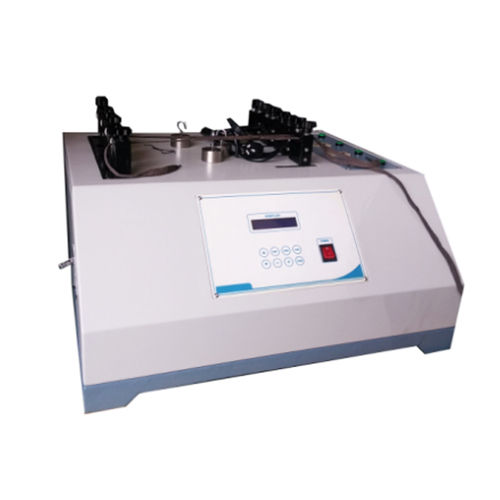
Shoes laces abrasion tester
Price 2850 USD ($)/ Unit
MOQ : 1 Unit
Shoes laces abrasion tester Specification
- Gas Pressure
- 0.5~0.7 MPa
- Accuracy
- 1 cycle
- Automation Grade
- Semi-automatic
- Interface Type
- Push button/Digital panel
- Humidity
- 40%~85% RH
- Port Size
- 1/8
- Response Time
- Instant
- Application
- Testing abrasion resistance of shoe laces
- Temperature
- 10C~35C
- Equipment Type
- Abrasion Tester
- Display Type
- Digital
- Frequency
- 50 Hz
- Operating Voltage
- 220V AC
- Measuring Range
- 0~999,999 cycles
- Test Range
- 0~999,999 cycles
- Features
- Stainless steel contact points, adjustable test parameters, automatic cycle counter
- Specimen Size
- Standard lace length
- Resolution
- 1 cycle
- Number of Specimens
- 2 pairs
- Mounting Type
- Table Top
- Power Supply
- 220V AC, 50 Hz
- Usage
- Quality Control/Testing Lab
- Capacity
- 2 samples/test
- Machine Weight
- Approx. 35 kg
- Test Speed
- 60 2 cycles/min
- Test Width
- 6 mm
- Test Stroke
- 35 mm
- Control Mode
- Manual / Digital
- Dimension (L x W x H)
- Approx. 600 x 300 x 400 mm
- Safety Device
- Emergency Stop Button
- Contact Material
- Stainless Steel
- Environmental Requirement
- Indoor, dust-free
- Drive Method
- Electric Motor Driven
- Abrasion Counter
- Digital Preset Counter
- Structure
- Powder coated steel body
Shoes laces abrasion tester Trade Information
- Minimum Order Quantity
- 1 Unit
- FOB Port
- Shenzhen
- Payment Terms
- Cash Against Delivery (CAD), Cash on Delivery (COD), Letter of Credit (L/C), Letter of Credit at Sight (Sight L/C), Paypal, Western Union, Delivery Point (DP), Telegraphic Transfer (T/T), Days after Acceptance (DA), Cash in Advance (CID), Cheque, Cash Advance (CA)
- Supply Ability
- 30 Units Per Month
- Delivery Time
- 15 Days
- Packaging Details
- Each set protected with resin fiber and PP film, then put into Strong wooden case with operation manual and video inside.
- Main Export Market(s)
- Australia, North America, South America, Eastern Europe, Middle East, Africa, Western Europe, Central America, Asia
- Certifications
- CE,ISO
Shoes laces abrasion tester About
Shoes laces abrasion tester HD-P808
THE USAGE:
Shoelace wearable performance: external anti-wear performance of shoelace,by indicating the number of times when shoelace subjected to repeated friction laces break,or by indicating whether shoelace part after a certain number of wear.
Parameters:
| Reciprocating frequence | 603times/min |
| Distance between a pair of gripper | 310mm~345mm |
| Reciprocating stroke | 352mm |
| Distance between two fixed point of a grippe | 25mm |
| Included angle | 52.2 |
| Heavy punch | 2501g |
| Counter | When reach set times,stop automatically |
Outstanding Durability and Precision
Equipped with stainless steel contact points and a robust powder-coated steel body, this abrasion tester ensures high accuracy (1 cycle) and longevity. The machine can endure rigorous, repeated use while consistently delivering reproducible results within a measuring range of 0 to 999,999 cycles. Its the ideal choice for manufacturers and testing labs committed to stringent quality standards.
User-Friendly Operation and Safety
This tabletop abrasion tester is designed with user convenience in mind. Its semi-automatic functionality allows for easy setup using a digital panel or push buttons. Crucial safety features, such as the emergency stop button, protect operators during testing. Adjustable parameters and a digital display make testing both intuitive and precise.
Versatile and Efficient Testing Capabilities
Test up to two pairs of standard-length shoe laces at once, optimizing laboratory throughput. With an adjustable test speed of 60 2 cycles/min, a preset digital counter, and a quick response time, this tester facilitates efficient quality assessment of lace durability. Indoor environmental requirements help guarantee reliable, repeatable results.
FAQs of Shoes laces abrasion tester:
Q: How does the shoe laces abrasion tester operate?
A: The abrasion tester is powered by an electric motor and uses stainless steel contact points to rub the shoe laces against a fixed surface for a specified number of cycles. Operation is managed through manual or digital controls, with the cycle count and test parameters set via a digital panel or push buttons.Q: What is the main benefit of using this abrasion tester in quality control?
A: The principal advantage is its high accuracy (1 cycle) and repeatability, ensuring reliable measurement of lace durability. This helps manufacturers guarantee the longevity and resilience of shoe laces in real-world use, supporting product quality and consistency.Q: Where is this machine typically installed and used?
A: This abrasion tester is intended for indoor, dust-free environments, such as quality control or testing laboratories in footwear manufacturing facilities. Its tabletop design and compact dimensions make it suitable for labs with limited space.Q: What types of shoe laces can be tested with this equipment?
A: The tester accommodates standard-length shoe laces, with a test width set at 6 mm. It can assess two pairs simultaneously, making it ideal for comparative testing of different lace materials or constructions.Q: How is safety ensured during operation?
A: The equipment is fitted with an emergency stop button, allowing the operator to halt the test immediately if necessary. Its robust and stable design further minimizes risk during operation.Q: What is the typical testing process for a pair of laces?
A: To test, install the laces in the specimen holders, set test parameters such as cycles and speed via the digital counter, and start the machine. The tester automatically counts and displays cycles, stopping automatically or via the emergency button if required. Results are read directly from the digital display.Q: When should the machine be calibrated or maintained?
A: Routine calibration and maintenance should be performed as per the manufacturers recommendations, typically before first use and periodically depending on test frequency. This maintains measurement accuracy and extends equipment life.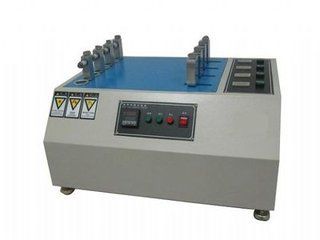
Tell us about your requirement

Price:
Quantity
Select Unit
- 50
- 100
- 200
- 250
- 500
- 1000+
Additional detail
Mobile number
Email

More Products in Shoes Test Equipment Category
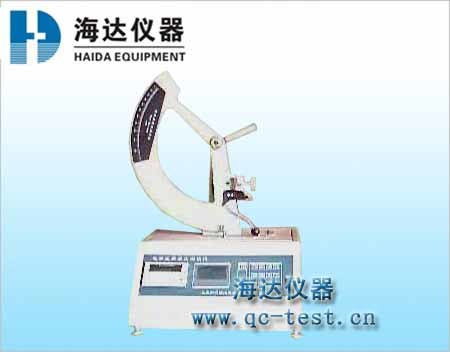
Shoe heel impact fatigue tester
Price 800 USD ($) / Unit
Minimum Order Quantity : 1 Unit
Test Stroke : 50 mm
Mounting Type : Freestanding
Machine Weight : Approx. 95 kg
Power Supply : AC 220V 10%, 50Hz
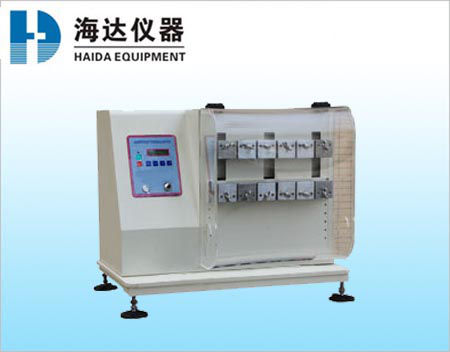
Shoe flexing machine
Price 2800 USD ($) / Unit
Minimum Order Quantity : 1 Unit
Test Stroke : 2550 mm (adjustable)
Mounting Type : Tabletop
Machine Weight : Approx. 70 kg
Power Supply : 220V AC, 50Hz
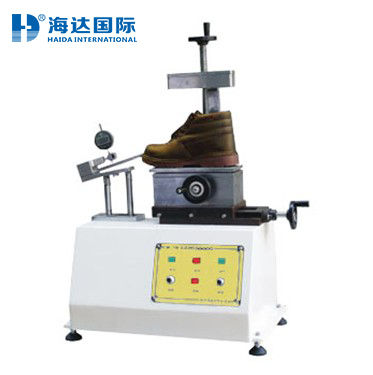
Shoe peeling strength testing machine
Price 2000 USD ($) / Unit
Minimum Order Quantity : 1 Unit
Test Stroke : 100 mm
Mounting Type : Table top
Machine Weight : approx. 65 kg
Power Supply : AC 220V, 50Hz
Shoe Lace Abrasion Tester
Price 2800 USD ($) / Unit
Minimum Order Quantity : 1 Unit
Test Stroke : 35 mm
Mounting Type : Tabletop
Machine Weight : 45 kg
Power Supply : AC 220V, 50Hz

Contact Details
- FACTORY ADD: No.13 Daxin Street, Daluosha Industrial Zone, Daojiao Town,Dongguan - 523710, Guangdong, China
- Phone :86-1591-7693151
- haidads@qc-test.cn
 Send Inquiry
Email us : haidads@qc-test.cn
- Ms Lisa (Manager)
- Mobile : +8613662707979, +8613829267288, +8615016776323, +8618373745787, +8618236912012, +8613602361535, +8613925747786

|


 |
HAIDA INTERNATIONAL EQUIPMENT CO., LTD.
All Rights Reserved.(Terms of Use) Developed and Managed by Infocom Network Private Limited. |
