

 English
 Spanish
 French
 German
 Italian
 Chinese (Simplified)
 Japanese
 Korean
 Arabic
 Portuguese
 Send Inquiry
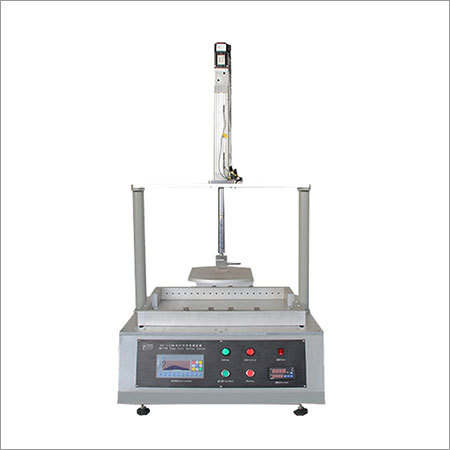
Chair Backrest Durability Testing Machine
MOQ : 1 Set
Chair Backrest Durability Testing Machine Specification
- Frequency
- 50Hz
- Port Size
- 8 mm pneumatic connector
- Measuring Range
- 10~150 kgf
- Test Range
- 10~150 kgf
- Application
- For cyclic durability and strength testing of chair backrests
- Resolution
- 0.1 kgf
- Power Supply
- 220V AC, 50Hz
- Automation Grade
- Automatic
- Interface Type
- Touch screen
- Equipment Type
- Chair Backrest Durability Testing Machine
- Operating Voltage
- 220V
- Specimen Size
- Chair backrest max width 600 mm
- Temperature
- 10C~40C
- Max Height
- 1800 mm
- Hardness
- Applicable for plastic, metal or wooden backrests
- Gas Pressure
- 0.5~0.8 MPa
- Mounting Type
- Floor-mounted
- Humidity
- 20%~80% RH
- Accuracy
- 1% F.S.
- Response Time
- 0.1 sec
- Number of Specimens
- 1 specimen per test
- Display Type
- Digital LCD display
- Features
- Programmable cycles, safety enclosure, automatic stop
- Usage
- Laboratory and industrial testing
- Capacity
- 150 kg max loading
- Machine Weight
- Approx. 150 kg
- Test Speed
- 5-30 cycles/min adjustable
- Test Width
- 600 mm
- Test Stroke
- 0-300 mm
- Control Mode
- PLC control with digital interface
- Actuator Type
- Servo pneumatic cylinder
- Calibration
- Supplied with calibration certificate
- Test Pressure Adjustment
- Precise manual and automated
- Noise Level
- 70 dB(A)
- Structure Material
- High-grade steel with powder coating
- Data Logging
- Built-in USB export and on-screen storage
- Safety Protection
- Emergency stop and safety interlock system
- Cycle Counter
- Digital automatic counter up to 999,999 cycles
- Equipment Dimensions
- Approx. 1200 x 700 x 1600 mm (LxWxH)
- Fixture Adjustment
- Adjustable for different backrest shapes and angles
Chair Backrest Durability Testing Machine Trade Information
- Minimum Order Quantity
- 1 Set
- FOB Port
- shenzhen
- Payment Terms
- Cash Against Delivery (CAD), Cash on Delivery (COD), Delivery Point (DP), Cheque, Letter of Credit (L/C), Letter of Credit at Sight (Sight L/C), Paypal, Western Union, Telegraphic Transfer (T/T), Days after Acceptance (DA), Cash in Advance (CID), Cash Advance (CA)
- Supply Ability
- 150 Sets Per Month
- Delivery Time
- 20 Days
- Packaging Details
- Each set protected with resin fiber and PP film, then put into Strong wooden case with operation manual and video inside.
- Main Export Market(s)
- Australia, Eastern Europe, Middle East, Western Europe, Africa, Central America, South America, Asia, North America
Chair Backrest Durability Testing Machine About
The usage
Chair Backrest Durability Testing Machine is to evaluate the ability of the chair back to withstand the fatigue stress and wear that occur as the result of user exerting backward pressure on the chair.
the testing methods:fix chair and impose a poise of 225pounds on the seat surface and keep the tilt mechanism reciprocating movement within its front and back limits for 300000 times at a speed of 10-30cpm.
Applicability
This test shall be performed on Type Il and lll chairs.
Type II - Fixed seat angle, tilting backrest
Type lll - Fixed seat angle, fixed backrest
Note: This test does not apply to chairs with backrest height less than 200 mm (7.9 in.).
Purpose of Test
The purpose of this test is to evaluate the ability of the chairs to withstand fatigue stresses and
wear caused by rearward force on the backrest of the chair.
Specifications
Office Chair Back Durability Tester
1.Professional design
2.High quality with reasonable price
3.One year warranty free.
The parameters
Height of Seat Back | 500~1200 mm or specified |
Weight of Seat | 225 lb or specified |
Air Pressure | 0~150 Ib |
Stroke | 0~18 in |
Force Angle | 0~90 |
Test Speed | 16 - 20 times/min or specified |
Counter | LCD, 0~999, 999 |
Dimension (WDH) | 66 136 140 cm |
Weight | 549 kg |
Power | AC220V, 3A |
Advanced Durability Testing
This machine excels at simulating real-world stress on chair backrests, making it indispensable for manufacturers, laboratories, and quality control teams. Its precise servo pneumatic actuator and programmable cycle counter allow for extensive and repeatable tests, with up to 999,999 cycles available for in-depth evaluation. With its strong steel structure and powder coating, long-term service and reliability are assured.
Comprehensive Safety and Control
Operators benefit from a well-integrated safety enclosure, emergency stop, and safety interlock system. Adjustable test parameters and a user-friendly PLC-controlled digital touch screen interface ensure simple operation and highly customizable testing scenarios. Results are easy to record and export via USB or on-screen storage, lending transparency to quality verification processes.
FAQs of Chair Backrest Durability Testing Machine:
Q: How does the Chair Backrest Durability Testing Machine ensure accurate and reliable results?
A: The machine is equipped with a servo pneumatic cylinder and digital automatic counter, providing high repeatability and precise control over test parameters. Its calibration certificate guarantees accuracy within 1% F.S., while digital LCD displays and automated data logging minimize human error.Q: What types of backrests can be tested with this machine?
A: This device accommodates plastic, metal, or wooden backrests, supporting widths up to 600 mm. The fixture is fully adjustable, allowing accurate alignment and force application for various shapes and angles.Q: When should the durability test be performed?
A: Durability testing is recommended whenever new chair designs are developed, materials or suppliers change, or as part of periodic quality assessments to ensure compliance with performance standards before market release.Q: Where can this machine be installed and used?
A: The machine is floor-mounted and designed for use in both industrial production settings and laboratory environments. Its moderate dimensions (approx. 1200 x 700 x 1600 mm) allow placement in standard testing facilities.Q: What is the process for conducting a test with this equipment?
A: To perform a test, adjust the fixture for the specific backrest, set the required test parameters via the touch screen interface, load the specimen, and initiate the automated cycle. The machine will apply the programmed number of cycles and test force, logging data for later analysis.Q: How does the built-in safety system protect operators during use?
A: Safety protections include an emergency stop and safety interlock system within a safety enclosure. These features help prevent unintended operation and minimize the risk of accidents during testing.Q: What benefits does programmable automation provide for backrest testing?
A: Programmable cycles, test force, stroke, and speed allow consistent, repeatable tests and efficient workflow. Automated data storage and export streamline quality documentation, reducing testing time and increasing productivity.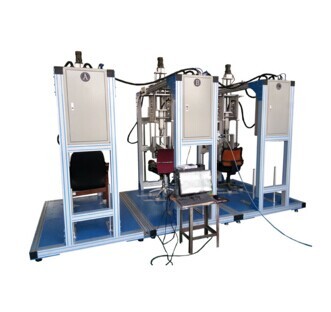
Tell us about your requirement

Price:
Quantity
Select Unit
- 50
- 100
- 200
- 250
- 500
- 1000+
Additional detail
Mobile number
Email

More Products in Furniture Test Equipment Category
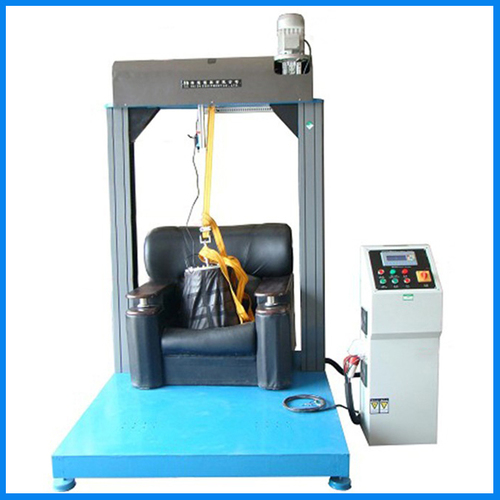
Chair Seating Cyclic Impact Test Equipment
Price 3500 USD ($) / Unit
Minimum Order Quantity : 1 Unit
Power Supply : 220V / 50Hz
Application : Dynamic cyclic impact test for chair seating durability
Usage : Furniture test laboratories, Chair manufacturers
Response Time : <0.5s
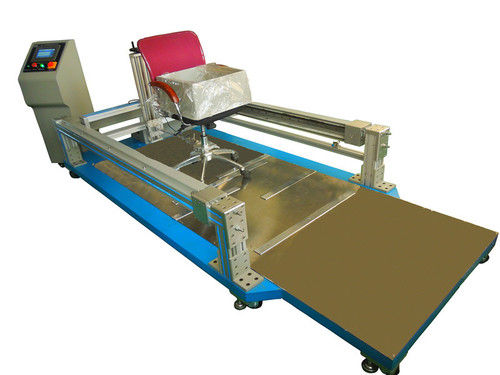
Variable Frequency Motor Office Chair Caster Fatigue Test Machine
Price 6300 USD ($) / Unit
Minimum Order Quantity : 1 Unit
Power Supply : AC 220V, 50 Hz
Application : Chair caster durability and fatigue testing
Usage : Office chair caster rolling test
Response Time : <1 second
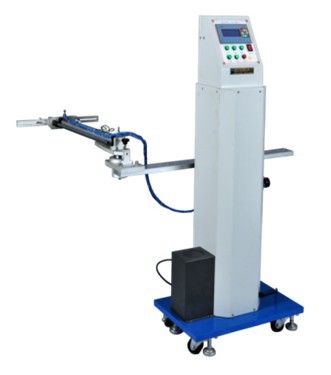
Drawer and door durability tester
Price 900 USD ($) / Set
Minimum Order Quantity : 1 Set
Power Supply : AC 220V, 50/60Hz
Application : Testing the durability of drawers and doors
Usage : Furniture hardware testing laboratories
Response Time : <1 s
Sofa Spring - Seat Bag Cotton Tester
Minimum Order Quantity : 1 Set
Power Supply : 220V, 50Hz AC
Application : Seat cushion and sofa spring testing
Usage : Testing seat cushion spring/cotton durability
Response Time : 1 sec

Contact Details
- FACTORY ADD: No.13 Daxin Street, Daluosha Industrial Zone, Daojiao Town,Dongguan - 523710, Guangdong, China
- Phone :86-1591-7693151
- haidads@qc-test.cn
 Send Inquiry
Email us : haidads@qc-test.cn
- Ms Lisa (Manager)
- Mobile : +8613662707979, +8613829267288, +8615016776323, +8618373745787, +8618236912012, +8613602361535, +8613925747786

|


 |
HAIDA INTERNATIONAL EQUIPMENT CO., LTD.
All Rights Reserved.(Terms of Use) Developed and Managed by Infocom Network Private Limited. |
