

 English
 Spanish
 French
 German
 Italian
 Chinese (Simplified)
 Japanese
 Korean
 Arabic
 Portuguese
 Send Inquiry
Salt Spray Corrosion Testing Equipment
Price 789 USD ($)/ Unit
MOQ : 1 Unit
Salt Spray Corrosion Testing Equipment Specification
- Output
- Automatic mist generation
- Input
- Compressed air (5-7 bar)
- Product Type
- Salt Spray Corrosion Testing Equipment
- Usage
- Accelerated corrosion testing of materials and surface coatings
- Efficiency
- High atomization for uniform salt mist coverage
- Standard
- ASTM B117 / ISO 9227
- Insulation Material
- Corrosion-resistant fiberglass reinforced plastic (FRP)
- Power
- 220V AC, 1.5 kW
- Control Type
- Programmable digital controller
- Accuracy
- ±1°C (temperature control)
- Voltage
- 220V
- Size
- Standard chamber: 1080 x 700 x 1200 mm
- Color
- Gray / Off-white
- Dimension (L*W*H)
- 1080 mm x 700 mm x 1200 mm
- Weight
- Approx. 90 kg
- Drainage System
- Automatic with corrosion-resistant fittings
- Material of Construction
- FRP inner body, SUS304 stainless steel fittings
- Ambient Temperature Tolerance
- Up to 35C
- Chamber Capacity
- 300 Liters
- Sample Holder
- Adjustable racks for diverse specimen sizes
- Temperature Range
- 35C to 50C
- Test Solution Capacity
- 40 Liters
- Spray Volume
- 1.5 to 2 ml/80cm2/hr
- Safety Features
- Over-temperature protection, low-water level alarm
- Humidity Control
- Integrated humidity regulator
- Installation Type
- Floor mounted
- Viewing Window
- Transparent acrylic for observation
- Timer
- Programmable up to 999 hours
- Temperature Uniformity
- 2C
- Mist Atomizer
- High-precision atomizing nozzles
Salt Spray Corrosion Testing Equipment Trade Information
- Minimum Order Quantity
- 1 Unit
- FOB Port
- Shenzhen China
- Supply Ability
- 10 Units Per Month
- Delivery Time
- 1 Week
- Packaging Details
- Each set protected with resin fiber and PP film, then put into Strong wooden case with operation manual and video inside.
Salt Spray Corrosion Testing Equipment About
Salt Spray Corrosion Testing Equipment
Specifications
Salt Spray Corrosion Testing Equipment
- Durable hard PVC construction ;
- reservoir with mixing system on stand
Introduction:
Salt Spray Corrosion Testing Equipment is the use of salt spray corrosion way to detect corrosion, respectively, the reliability of the sample, salt spray refers to the atmosphere by diffusion system composed of tiny droplets of salt, artificial environment of three anti-series one of many companies need to simulate the destructive product of marine climate surrounding the product caused by salt spray chamber so the line should run.
Features:
- Local temperature and humidity inside and outside the box are used for A-level gray high-corrosive PVC, for salt spray, copper acetate, and other test specifications Test
- It uses the A-level German imports of gray PVC material.
- It uses sophisticated Class A gray PVC material designed "V" shape long, products tested by the 15o -30o angle be adjusted.
- . It uses a 5mm thick transparent imported high toughness PVC board, bending method designed to cover 100 degree ridge-type transparent with power failure memory function of time, so after the original call time to complete the remaining time of the experimental work, with a double over-temperature protection, water shortage warning, ensure safety
- According to JIS, ASTM, CNS, GB standard parameter setting operation.
experiment method
- GB / T2423.17-2008 salt spray test method
- GB / T 2423.18-2000 "basic procedures for electric and electronic products Test Ka"
- GB / T10125-1997 Corrosion tests in artificial atmospheres - salt spray test _
- Technical conditions GB / T10587-2006 salt spray test chamber
- GB10593.2-1990 electric and electronic products environmental parameters measurements
- GB / T1765-1979 Determination of resistance to humidity, salt spray, weather resistance (artificial acceleration) of the film prepared test
Specifications :
| Model | HD-E808-200 Spray Testing Machine |
| Inner Box Size ( LxWxH ) | 200x100x60 cm |
| Outside Box Size ( LxWxH ) | 270x150x150 cm |
| Equipment Material | Both inside & outside shell adopt imported P . V . C rigid plastic board , and tank cover uses imported transparent P . V . C . rigid plastic board |
| Temperature Range | 35 C 55 C |
| Temperature Fluctuations | 0 . 5 C |
| Temperature Uniformity | 2 C |
| Temperature Precision | 1 C |
|
| Salt Spray Method ( NSS ACSS ) 35 1 C |
| Saturated air Barrel Temperature | Salt Spray Method ( NSS ACSS ) 47 1C |
| Brine Temperature | 35C 1 C |
| Spray Quantity | 1 . 0 2 . 0 ml / 80cm2 / hr |
| PH | Salt Spray Method ( NSS ACSS6 . 5 7 . 2 ) |
| Lab Volume | 1440L |
| Brine Tank Capacity | 40L |
| Power | AC220V , 30A |
| Multiple Safety Protection Devices | Current discharge protection , over pressure protection , over temperature protection , over load fuse protection |
| Accessories | Testing Salt/ Measuring tank/ Equipment each 1 set |
| Standard | CNS : 3627 , 3385 , 4159 , 7669 , 8886 ;
|
Superior Construction for Reliable Testing
Built with a FRP inner body and SUS304 stainless steel fittings, this equipment ensures strong resistance to corrosion and physical wear. The chambers insulation, made from fiberglass reinforced plastic, maintains stable internal conditions, supporting repeatable and accurate salt spray tests for all materials and surface coatings.
Advanced Control and Safety Features
A digital programmable controller provides easy management of time and temperature, with a range from 35C to 50C and 1C control accuracy. Safety is reinforced with over-temperature protection and a low-water level alarm, while automatic drainage and humidity regulation streamline daily operations.
Versatile Capacity and User Convenience
The device accommodates up to 300 liters in the chamber and 40 liters of test solution, supporting a variety of sample sizes with its adjustable racks. A transparent acrylic viewing window allows for effortless observation, and a high-precision atomizer assures consistent mist coverage for reliable corrosion results.
FAQs of Salt Spray Corrosion Testing Equipment:
Q: How is the Salt Spray Corrosion Testing Equipment operated?
A: Operation is straightforward with a programmable digital controller that manages test time (up to 999 hours), temperature (35C50C), and humidity. Specimens are placed on adjustable racks, and the chambers high-precision atomizing nozzles distribute the saline mist uniformly to simulate corrosive environments.Q: What materials and coatings can be tested using this equipment?
A: This equipment is suitable for accelerated corrosion testing of metals, alloys, painted components, and various surface coatings. It follows ASTM B117 and ISO 9227 standards, ensuring results are recognized across industries including automotive, aerospace, marine, and manufacturing.Q: When should I use salt spray testing for my products?
A: Salt spray testing is recommended during new product development, materials research, or quality assurance processes to assess the corrosion resistance of materials or protective coatings. It helps ensure products meet industry durability standards before market release or large-scale production.Q: Where is the best location to install this equipment?
A: Since the unit is floor-mounted and has a robust build, it should be installed in a laboratory or production facility with access to a 220V AC power supply, compressed air (5-7 bar), and adequate ventilation. Ensure ambient temperatures do not exceed 35C for optimal performance.Q: What is the testing process using this chamber?
A: The process involves placing cleaned test specimens on the adjustable racks, filling the chamber with the standard saline solution (up to 40 liters), setting the desired test parameters, and starting the programmed cycle. The chamber maintains uniform temperature and mist coverage throughout the set duration.Q: How does the equipment ensure operator safety and sample integrity?
A: Safety is enhanced by features like over-temperature protection, a low-water level alarm, and an automatic corrosion-resistant drainage system. These functions help prevent accidents, preserve sample integrity, and reduce the risk of operational interruptions.Q: What benefits does this equipment offer over conventional methods?
A: With high-efficiency atomization and precise environmental control, this chamber delivers rapid, repeatable, and standardized corrosion assessments. Its robust materials of construction, large chamber capacity, and advanced automation make it ideal for demanding testing scenarios, ultimately supporting better product quality and longevity.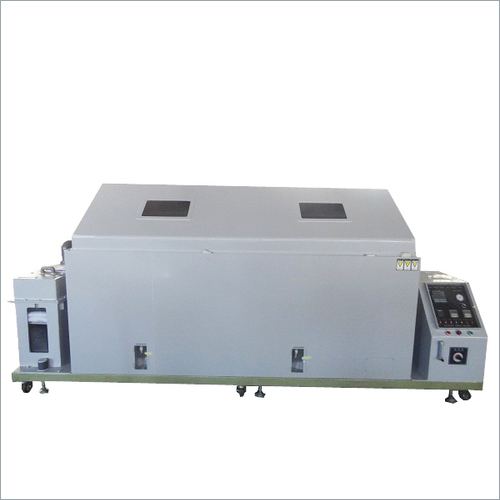
Tell us about your requirement

Price:
Quantity
Select Unit
- 50
- 100
- 200
- 250
- 500
- 1000+
Additional detail
Mobile number
Email

More Products in LED Aging Test Machine Category
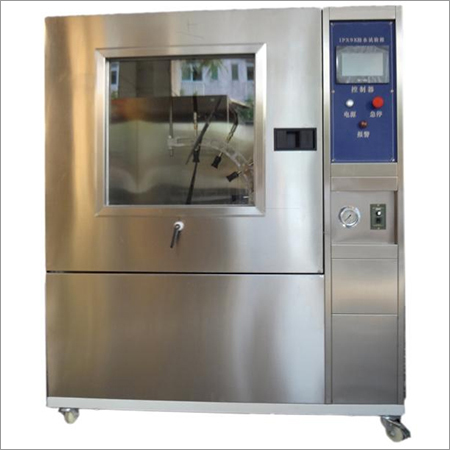
Rain Test Chamber
Price 2988 USD ($) / Unit
Minimum Order Quantity : 1 Unit
Accuracy : 5% water flow rate
Output : Water flow rate adjustable
Standard : IEC 60529 (IPX1/IPX2/IPX3/IPX4)
Size : Customized test area sizes available

Led Dust Test Chamber
Price 4788 USD ($) / Unit
Minimum Order Quantity : 1 Unit
Accuracy : 2% RH and 1C
Output : Programmable
Standard : IEC 60529, IS 12063, JIS D0207, GB420893, IP5X/IP6X
Size : Standard / Customizable
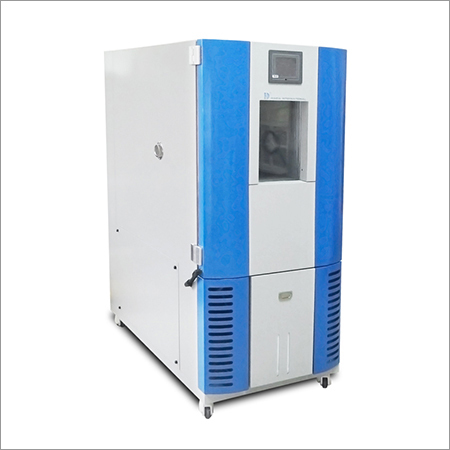
Led Light Aging Climate Testing Machine
Price 4000 USD ($) / Unit
Minimum Order Quantity : 1 Unit
Accuracy : 0.1C (Temperature), 2%RH (Humidity)
Output : Test Data, Performance Graphs, Temperature & Humidity Logs
Standard : International Testing Standards (IEC, IS, ASTM as applicable)
Size : Customizable (Standard: Medium, Large)

Contact Details
- FACTORY ADD: No.13 Daxin Street, Daluosha Industrial Zone, Daojiao Town,Dongguan - 523710, Guangdong, China
- Phone :86-1591-7693151
- haidads@qc-test.cn
 Send Inquiry
Email us : haidads@qc-test.cn
- Ms Lisa (Manager)
- Mobile : +8613662707979, +8613829267288, +8615016776323, +8618373745787, +8618236912012, +8613602361535, +8613925747786

|


 |
HAIDA INTERNATIONAL EQUIPMENT CO., LTD.
All Rights Reserved.(Terms of Use) Developed and Managed by Infocom Network Private Limited. |
