

 English
 Spanish
 French
 German
 Italian
 Chinese (Simplified)
 Japanese
 Korean
 Arabic
 Portuguese
 Send Inquiry
Rubber repeated compression test machine
Price 1400 USD ($)/ Unit
MOQ : 1 Unit
Rubber repeated compression test machine Specification
- Number of Specimens
- 1 6
- Response Time
- 1 s
- Frequency
- 0.5 - 5 Hz
- Interface Type
- RS232/USB
- Measuring Range
- 1 50 kN
- Resolution
- 0.001 kN
- Operating Voltage
- 220 V
- Display Type
- Digital LCD Display
- Temperature
- 5C 60C
- Features
- Auto-stop, Overload protection, Data logging
- Max Height
- 650 mm
- Port Size
- 1/4 inch
- Gas Pressure
- 0 8 bar
- Hardness
- Applicable to 20 90 Shore A
- Power Supply
- AC 220V, 50Hz
- Mounting Type
- Free-standing
- Application
- Rubber repeated compression fatigue resistance testing
- Specimen Size
- Diameter: 29 mm; Height: 12.5 mm
- Equipment Type
- Rubber repeated compression test machine
- Humidity
- 20% 95% RH
- Automation Grade
- Semi-Automatic
- Test Range
- up to 50 kN
- Accuracy
- 1%
- Usage
- Laboratory, Industrial testing
- Capacity
- 50 kN
- Machine Weight
- Approx. 120 kg
- Test Speed
- 0.1 500 mm/min
- Test Width
- 150 mm
- Test Stroke
- 0 100 mm adjustable
- Control Mode
- Digital Microprocessor Control
- Cycle Counter
- Digital, Programmable
- Dimensions (LxWxH)
- 600 x 400 x 450 mm
- Sample Placement
- Removable jig
- Color
- Industrial Grey
- Data Output
- USB/Printer
- Compliance Standard
- ASTM D575, ISO 815
- Frame Material
- Stainless Steel
- Noise Level
- <60 dB
- Specimen Fixture Type
- Adjustable Clamp
- Safety Feature
- Overload/Overtemperature Protection
Rubber repeated compression test machine Trade Information
- Minimum Order Quantity
- 1 Unit
- FOB Port
- Shenzhen
- Supply Ability
- 30 Units Per Month
- Delivery Time
- 15 Days
- Packaging Details
- Each set protected with resin fiber and PP film, then put into Strong wooden case with operation manual and video inside.
- Certifications
- CE,ISO
Rubber repeated compression test machine About
The usage:
Take standards specimen on the between the two standards plates,at the 60times/min,repeated compression 80,000 times,then removing the specimen,and measure its thickness after 30min.
The main parameter:
- Specimen:50*50mm/100*100mm
- Compression speed:60c.p.(1HZ)
- Compression travel:050mm(adjustable)
- Counter:LCD,0999,999
Precision Testing for Rubber Components
Designed to meet the rigorous ASTM D575 and ISO 815 standards, this machine supports advanced fatigue resistance testing for rubber components. The digital control system and programmable cycle counter allow precise configuration and reliable repeatability, while the adjustable fixture accommodates various specimen sizes. Its removable jig ensures seamless placement and retrieval, enhancing user efficiency during multiple test sequences.
Advanced Data Management and Safety
Equipped with digital LCD display and options for USB, RS232, and printer data output, this tester ensures precise monitoring and reporting. Effortless data logging combines with reliable overload and overtemperature protection, keeping workflows safe and seamless. Its low-noise performance (below 60 dB) and ergonomic industrial grey build make it ideal for continuous laboratory usage and automated testing regimes.
Versatile Application Across Industries
Whether you are a manufacturer, dealer, or laboratory technician, this rubber repeated compression test machine is engineered for versatile use. Capable of handling 1 to 6 specimens simultaneously, it streamlines quality assurance workflows in diverse settings from research and development laboratories to industrial quality control processes, offering automation and semi-automatic operation for increased productivity.
FAQs of Rubber repeated compression test machine:
Q: How does the rubber repeated compression test machine operate?
A: The machine utilizes a programmable, digital microprocessor control system. Specimens are clamped with the adjustable fixture and secured onto the removable jig. The test is set with precise parameters such as speed, stroke, and frequency, with real-time feedback shown on the digital LCD display. Data can be logged and exported via USB, RS232, or direct printing.Q: What types of specimens can I test with this equipment?
A: You can test 1 to 6 rubber specimens at once, each with a diameter of 29 mm and height of 12.5 mm. The fixture is adjustable, accommodating hardness from 20 to 90 Shore A, making it adaptable for various rubber formulations as required by ASTM D575 or ISO 815 standards.Q: When is it beneficial to use this compression test machine?
A: This machine is ideal whenever you need to assess the fatigue resistance and long-term durability of rubber materials in repeated compression scenarios. It is primarily used during product development, quality control, and compliance testing, ensuring your products meet required industry standards.Q: Where is this machine typically used?
A: The unit is widely used in laboratories, industrial testing facilities, and research and development centers. Its rugged stainless steel construction and compliance with key international standards make it suitable for both small-scale and high-throughput environments.Q: What is the process for setting up and running a compression fatigue test?
A: First, secure the rubber specimens using the adjustable clamps and removable jig. Configure your test parameters such as cycle count, test speed (0.1500 mm/min), test stroke (up to 100 mm), and frequency (0.55 Hz) using the digital control interface. Initiate testing and monitor results via the LCD display. Download or print your results at completion.Q: How does the machine ensure safety during operation?
A: The machine features overload and overtemperature protection, along with auto-stop functionality. These controls automatically halt operations if abnormal conditions are detected, safeguarding both the operator and test samples.Q: What are the key benefits of using this test machine?
A: Key benefits include high measurement precision (1%), fast response time (1 s), versatile data output, and compliance with major standards. Its semi-automatic, programmable operation saves time and reduces manual errors. The sturdy stainless steel frame and low noise operation (<60 dB) further add value for reliable, long-term laboratory or industrial use.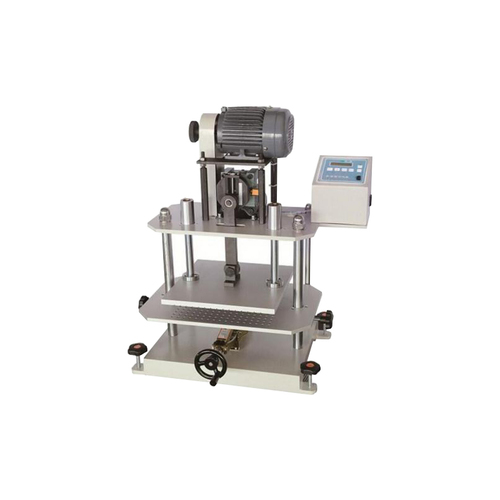
Tell us about your requirement

Price:
Quantity
Select Unit
- 50
- 100
- 200
- 250
- 500
- 1000+
Additional detail
Mobile number
Email

More Products in Optical Test Equipment Category
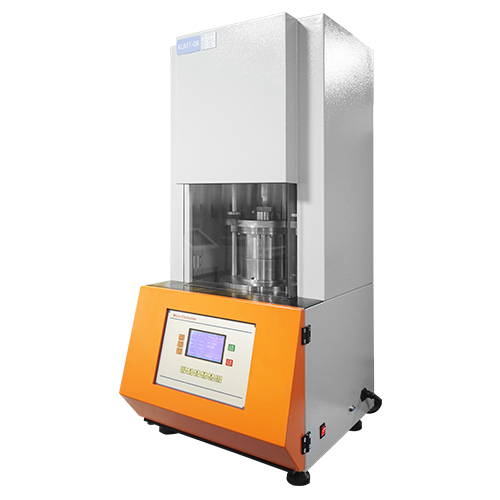
Rubber without rotor rheometer
Price 899 USD ($) / Unit
Minimum Order Quantity : 1 Unit
Application : Rubber vulcanization measurement and QC
Mounting Type : Tabletop
Usage : Laboratory and Industrial
Power Supply : 220V/50Hz AC
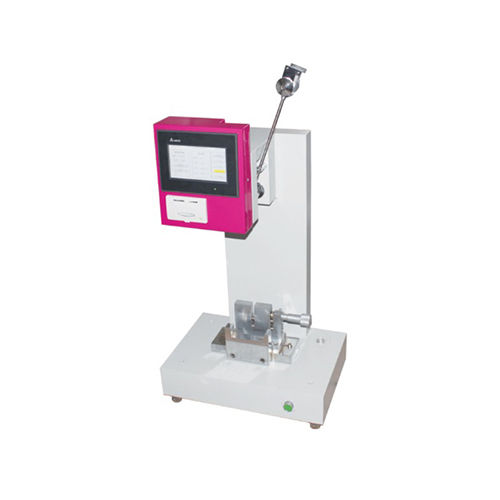
Digital Impact Tester
Price 1300 USD ($) / Unit
Minimum Order Quantity : 1 Unit
Application : Impact resistance testing of various materials
Mounting Type : Benchtop
Usage : Lab/Industrial materials testing
Power Supply : 220V AC, 50Hz
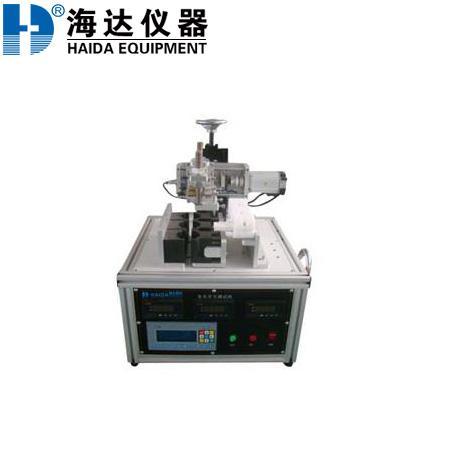
Hair straightener`s switch endurance test machine
Minimum Order Quantity : 1
Application : Switch endurance testing for hair straighteners
Mounting Type : Benchtop
Usage : Laboratory/Quality Control
Power Supply : AC 220V, 50Hz

Industrial Projector
Minimum Order Quantity : 1 Set
Application : Precision Projection, Quality Inspection, Measuring, Industrial Visualization
Mounting Type : Bench / Floor Mount
Usage : Industrial Metrology / Inspection
Power Supply : 220V AC, 50Hz

Contact Details
- FACTORY ADD: No.13 Daxin Street, Daluosha Industrial Zone, Daojiao Town,Dongguan - 523710, Guangdong, China
- Phone :86-1591-7693151
- haidads@qc-test.cn
 Send Inquiry
Email us : haidads@qc-test.cn
- Ms Lisa (Manager)
- Mobile : +8613662707979, +8613829267288, +8615016776323, +8618373745787, +8618236912012, +8613602361535, +8613925747786

|


 |
HAIDA INTERNATIONAL EQUIPMENT CO., LTD.
All Rights Reserved.(Terms of Use) Developed and Managed by Infocom Network Private Limited. |
