

 English
 Spanish
 French
 German
 Italian
 Chinese (Simplified)
 Japanese
 Korean
 Arabic
 Portuguese
 Send Inquiry
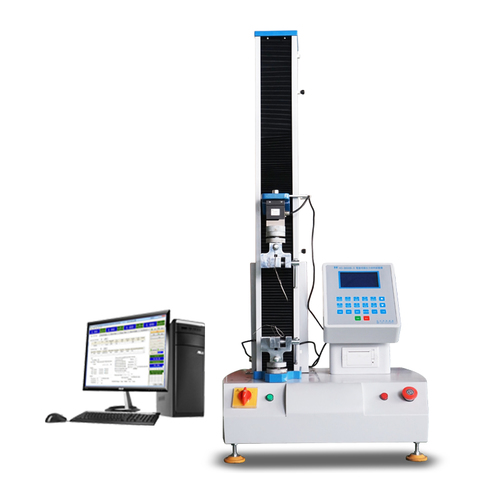
PC & PLC Display Fiber Tensile Strength Testing
Price 1499 USD ($)/ Unit
MOQ : 1 Unit
PC & PLC Display Fiber Tensile Strength Testing Specification
- Frequency
- 50 Hz
- Control System
- PLC & PC based
- Voltage
- 220 V
- Machine Speed
- 10-500 mm/min
- Operating Temperature
- 10°C to 40°C
- Resolution
- 0.01 N
- Power Consumption
- 800 W
- Application
- Tensile testing of optical fibers, yarns, and fabrics
- Power Source
- Electric
- Dimension (L*W*H)
- 600 x 400 x 1500 mm
- Load Capacity
- 1 kN
- Power
- 220V, 50Hz
- Product Type
- Fiber Tensile Strength Testing Machine
- Features
- PC & PLC display, highly accurate, USB connectivity, programmable control, microprocessor-based system, overload protection
- Stroke Length
- 700 mm
- Color
- White & Blue
- Capacity
- up to 1000 N
- Phase
- Single Phase
- Screw Size
- Ball Screw 20 mm
- Accuracy
- ±1%
- Sensor
- Load Cell
- Weight
- 125 kg
- Speed Range
- 10-500 mm/min
- Automatic Grade
- Automatic
- Material
- Mild Steel
- Software Features
- Customizable report generation, multi-language support, test result comparison
- Operating Humidity
- 80% RH (non-condensing)
- Safety Features
- Emergency stop button, overload protection, up/down travel limiters
- Test Modes
- Tensile, Elongation, Breaking force
- Display Type
- Large graphical LCD/PC & PLC digital interface
- Data Output
- USB and RS232 ports
- Sample Sets
- Multiple samples concurrent test possible
- Test Curve Display
- Real-time force vs elongation curve
- Installation Type
- Floor-standing
- Clamp Type
- Pneumatic/Mechanical interchangeable grips
PC & PLC Display Fiber Tensile Strength Testing Trade Information
- Minimum Order Quantity
- 1 Unit
- FOB Port
- SHENZHEN
- Payment Terms
- Cash on Delivery (COD), Letter of Credit (L/C), Letter of Credit at Sight (Sight L/C), Western Union, Paypal, Cash Against Delivery (CAD), Delivery Point (DP), Telegraphic Transfer (T/T), Days after Acceptance (DA), Cash in Advance (CID), Cheque, Cash Advance (CA)
- Supply Ability
- 15 Units Per Week
- Delivery Time
- 5 Days
- Packaging Details
- Each set protected with resin fiber and PP film, then put into Strong wooden case with operation manual and video inside. CE,ISO
- Certifications
- Each set protected with resin fiber and PP film, then put into Strong wooden case with operation manual and video inside. CE,ISO
PC & PLC Display Fiber Tensile Strength Testing About
Electric PC and PLC Display Fiber Tensile Strength Testing
Product Description
Application
Fiber Tensile Strength Testing is used to test tension, compression, shearing force, adhesion, peeling force, tear strength,ect of specimen, semi product and finished product in the field of rubber, plastic, metal, nylon,fabric,paper, aviation, packing, architecture, petrochemistry, electric appliance, automobile,...etc. which are the basic facilities for input quality control (I.Q.C), Quality Control (Q.C.), Physical Inspection,Mechanics Research and Material Development.
Technical Parameters
| Items | Specification |
| Sensor | Celtron load cell |
| Capacity | 10,20,50,100,200kg |
| Unit Switchover | G, KG, N, LB |
| Display Device | PC and LCD |
| Resolution | 1/250,000 |
| Accuracy | 0.5% |
| Max. Stroke | 1000mm (including fixture) |
| Test Speed | 0.1-500mm/min (adjustable ) |
| Motor | Panasonic Servo Motor |
| Screw | High Precise Ball Screw |
| Elongation Accuracy | 0.001mm |
| Power | 220V, 50HZ |
| Weight | Approx.75kg |
| Accessories | One set tensile clamp, one set Lenovo computer, one piece English software CD, one piece operation video CD, one piece English user manual |
Versatile Display and Control System
The machine features a large graphical LCD along with PC and PLC digital interfaces, delivering highly accurate data and real-time graphical display. Its microprocessor-based architecture and programmable control offer flexibility and reliability for detailed analysis. Multiple language support and report customization make test management straightforward and adaptable to various operational needs.
Comprehensive Safety and Operational Features
Engineered for safety, this tester includes an emergency stop button, overload protection, and up/down travel limiters. These features, combined with floor-standing stability and sturdy construction, ensure user protection while maintaining performance integrity. The tester operates efficiently within a wide range of environmental conditions, withstanding up to 80% RH and temperatures from 10C to 40C.
Exceptional Test Capabilities and Connectivity
Supporting tensile, elongation, and breaking force test modes, the system accommodates multiple samples simultaneously. The interchangeable pneumatic and mechanical grips, 700mm stroke length, and a speed range of 10500 mm/min ensure adaptability to varying materials and test standards. USB and RS232 connectivity simplifies data transfer and integration with existing lab systems.
FAQs of PC & PLC Display Fiber Tensile Strength Testing:
Q: How do I operate the PC & PLC Display Fiber Tensile Strength Tester?
A: Start by securely installing the machine on a firm, floor-standing surface. Connect the power supply (220V, 50Hz) and link the PC or PLC interface via USB or RS232. Choose the desired grip type for your samplepneumatic or mechanicaland place your fiber, yarn, or fabric sample. Select your test mode (tensile, elongation, or breaking force) from the control panel, set parameters such as speed (10-500 mm/min), and use the graphical display or PC software to monitor progress. Emergency and safety features are readily accessible during testing.Q: What materials can be tested with this tensile strength testing machine?
A: This machine is specially designed for testing the tensile properties of optical fibers, various yarns, and different fabrics. Its interchangeable clamping system and high-capacity load cell make it suitable for a wide spectrum of sample types encountered in textile and fiber optic industries.Q: When should I use pneumatic versus mechanical grips?
A: Use pneumatic grips when rapid, consistent clamping force is needed for delicate or multiple samples. Mechanical grips are ideal for materials that require high clamping precision or unique sample shapes. Swapping grips is straightforward, allowing adaptation to diverse testing requirements without the need for additional equipment.Q: Where can I view and export my test results?
A: Results can be monitored in real time on the large LCD display or on your connected PC/PLC. Data is stored digitally and can be exported via USB or RS232 ports. The accompanying software lets you generate customizable reports, compare test results, and manage data for record-keeping and analysis.Q: What process does the tester use to ensure accurate measurements?
A: The testing machine utilizes a precision load cell sensor and ball screw mechanism (20 mm) to ensure repeatable, accurate measurements up to 1%. Real-time feedback and programmable controls help standardize test procedures, minimizing human error and improving consistency across multiple samples.Q: How do the safety features benefit the user?
A: The built-in emergency stop button, overload protection, and up/down limiters safeguard users and machinery during operation. These safety systems prevent accidents caused by sample breakage or equipment overload, ensuring reliable performance and user confidence at all stages of testing.Q: What are the benefits of PC & PLC based control in this equipment?
A: PC & PLC based control provides intuitive operation, enhanced data management, and seamless integration into laboratory workflows. Automatic functions, multi-language support, and advanced reporting capabilities save time, reduce operator errors, and facilitate compliance with international testing standards.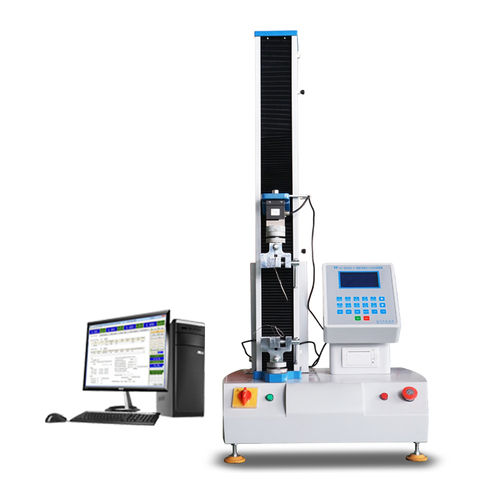
Tell us about your requirement

Price:
Quantity
Select Unit
- 50
- 100
- 200
- 250
- 500
- 1000+
Additional detail
Mobile number
Email

More Products in Tensile Testing Equipment Category
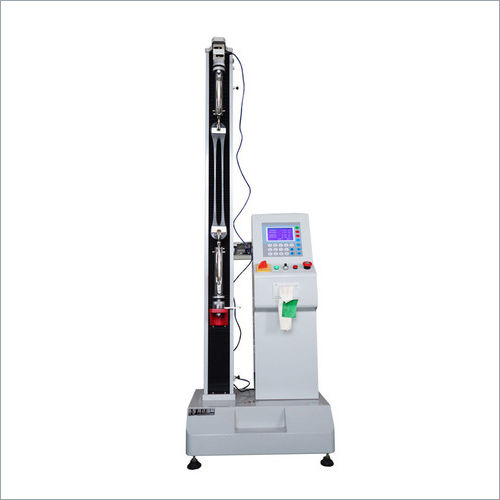
Peel Testing Equipment
Price 1369 USD ($) / Set
Minimum Order Quantity : 1 Set
Color : Blue and white
Power : 220V AC
Product Type : Peel Testing Equipment
Application : Adhesive Tapes, Laminates, Label, Foil, etc.
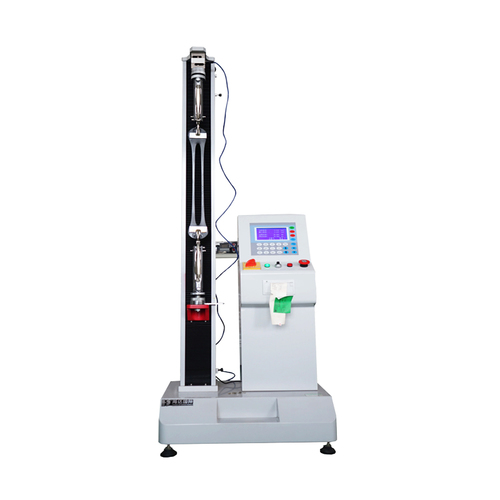
Factory Direct Wire shear Strength Test Machine
Price 900 USD ($) / Unit
Minimum Order Quantity : 1 Unit
Color : Industrial grey/blue
Power : AC 220V 10%, 50Hz
Product Type : Wire Shear Strength Test Machine
Application : Wire shear strength, cable testing, metal wire quality assurance
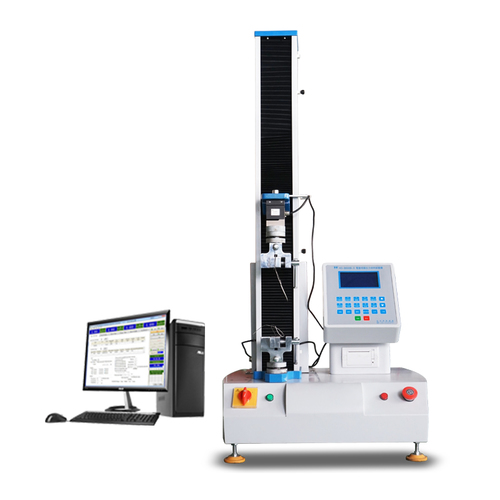
200KG Capacilty Universal Tensile Testing Machine
Price 2200 USD ($) / Unit
Minimum Order Quantity : 1 Unit
Color : Blue/Grey
Power : 220V AC, 50Hz
Product Type : Universal Tensile Testing Machine
Application : Tensile, Compression, Bending, Shear Testing of various materials
Computer Fabric Tensile Strength Test Machine
Price 1899 USD ($) / Set
Minimum Order Quantity : 1 Set
Color : Blue & Silver
Power : AC 220V 10%, 50Hz
Product Type : Computer Fabric Tensile Strength Test Machine
Application : Textile and fabric tensile testing

Contact Details
- FACTORY ADD: No.13 Daxin Street, Daluosha Industrial Zone, Daojiao Town,Dongguan - 523710, Guangdong, China
- Phone :86-1591-7693151
- haidads@qc-test.cn
 Send Inquiry
Email us : haidads@qc-test.cn
- Ms Lisa (Manager)
- Mobile : +8613662707979, +8613829267288, +8615016776323, +8618373745787, +8618236912012, +8613602361535, +8613925747786

|


 |
HAIDA INTERNATIONAL EQUIPMENT CO., LTD.
All Rights Reserved.(Terms of Use) Developed and Managed by Infocom Network Private Limited. |
