

 English
 Spanish
 French
 German
 Italian
 Chinese (Simplified)
 Japanese
 Korean
 Arabic
 Portuguese
 Send Inquiry
Digital Textile Tensile Testing Machine
Price 1899 USD ($)/ Unit
MOQ : 1 Unit
Digital Textile Tensile Testing Machine Specification
- Phase
- Single phase
- Power Consumption
- 500 W max
- Voltage
- 220V
- Capacity
- 250 kg
- Frequency
- 50 Hz
- Control System
- Microprocessor-based digital control
- Speed Range
- 50-500 mm/min adjustable
- Weight
- Approx. 120 kg
- Features
- Digital display, overload protection, automatic data recording
- Power
- 220V AC, 50Hz
- Application
- Strength and elongation testing of fabric, yarn, and textile samples
- Product Type
- Digital Textile Tensile Testing Machine
- Screw Size
- M16
- Color
- Blue and White
- Operating Temperature
- 10°C to 40°C
- Stroke Length
- 700 mm
- Resolution
- 0.01 N
- Load Capacity
- 2500 N (250 kgf)
- Accuracy
- ±1% of indicated value
- Power Source
- Electric
- Machine Speed
- Variable, electronically controlled
- Sensor
- Precision load cell
- Dimension (L*W*H)
- 800 x 600 x 1800 mm
- Automatic Grade
- Semi-automatic
- Material
- Mild steel with powder-coated finish
- Speed Accuracy
- 1%
- Elongation Range
- 0-800 mm
- Operating Environment
- Indoor, dust free, vibration free area
- Display Type
- Digital LCD
- Test Modes
- Tensile, Compression, and Bending
- User Interface
- Keypad operated with menu-driven software
- Standards Compliance
- ASTM D5034, ISO 13934-1
- Safety Features
- Emergency stop button and overload cutoff
- Sample Width Capability
- max. 50 mm
- Data Output
- RS232 interface for PC connectivity
- Clamping Unit
- Interchangeable grips for varied samples
- Humidity Range
- 20% to 80% RH (non-condensing)
Digital Textile Tensile Testing Machine Trade Information
- Minimum Order Quantity
- 1 Unit
- FOB Port
- SHENZHEN
- Payment Terms
- Cash on Delivery (COD), Paypal, Letter of Credit (L/C), Western Union, Letter of Credit at Sight (Sight L/C), Delivery Point (DP), Cash Against Delivery (CAD), Cash Advance (CA), Telegraphic Transfer (T/T), Days after Acceptance (DA), Cash in Advance (CID), Cheque
- Supply Ability
- 15 Units Per Week
- Delivery Time
- 5 Days
- Packaging Details
- Each set protected with resin fiber and PP film, then put into Strong wooden case with operation manual and video inside. CE,ISO
- Main Export Market(s)
- Middle East, Western Europe, Africa, South America, Asia, Central America, Eastern Europe, North America, Australia
- Certifications
- CE,ISO
Digital Textile Tensile Testing Machine About
Equipment summary:
Textile tensile testing machine is a simple type machine, simple structure, convenient operation, It can be tested on the operated table, Using the electronic control systems, load sensor is rising and falling to test the tension or compression through the motor rotation, transmission machinery and T-screws. This machine is simple to operate, especially suitable for controlling quality in production line, This series of machine is mainly applied to test the non-metallic and metallic materials which the load is less than 1KN.
Applicable industry:
Textile tensile testing machine widely used in wire and cable, hardware, electronic and electrical equipment, packaging, printing, medical equipment, auto parts, textiles and leather, clothing, shoes, rubber and plastic products, colleges and universities; research laboratories; inspection arbitration, technical supervision departments and many other industries, it is the basic equipment for quality management and physical tested.
Standard Features
| Item | Description |
| Frame capacity | 200kg |
| Load cell brand | China brand, 200kg (5,10,50,100kg are optional) |
| Load accuracy | 1% F.S |
| Control system | LCD with build-in printer /PC with windows 7 system |
| Motor | Adjustable-speed motor with reduction box, high-precision mechanical ball screw rod |
| Force reading | kgf, Ibf, N, KN, T etc |
| Vertical test space | 900mm including fixture |
| Test speed | 50~300mm/min (adjustable by rotary knob) |
| Software | TM 2101 |
| Curves display | Load- elongation, Elongation-time, Time-elongation, Stress-strain |
| Data display | Max. force, speed, sample information, strength(Kpa, Mpa, N/mm, N/mm2) etc |
| Safety features | E-Stop Over-load protection Upper and lower limit switches Load sensor with automatic retreat |
Precision Meets Versatility
This tensile testing machine excels in accuracy, providing 1% precision for both reading and speed control. A broad elongation range up to 800 mm and variable speed settings (50500 mm/min) allow tailored testing for diverse textile samples. The user-friendly keypad interface and LCD readout ensure seamless operation across all test modes.
Advanced Safety and Durability
Built with robust mild steel and finished with powder coating, the machine delivers enhanced durability. Emergency stop and overload cutoff mechanisms safeguard users and equipment alike. The dust- and vibration-free indoor operational requirements further protect test integrity and extend machine longevity.
Comprehensive Data and Connectivity
Automated data recording coupled with a RS232 interface allows effortless results transfer to PCs for documentation and analysis. The menu-driven software provides comprehensive control, making test setup, operation, and data management smooth and traceable for manufacturers, quality controllers, and researchers.
FAQs of Digital Textile Tensile Testing Machine:
Q: How do I operate the Digital Textile Tensile Testing Machine for elongation and strength measurement?
A: To measure elongation and strength, select the desired test mode using the keypad menu. Install the sample using interchangeable grips, configure parameters like speed, and initiate testing. Results are displayed digitally and can be exported via RS232 to a PC.Q: What types of samples can be tested with interchangeable grips on this machine?
A: The interchangeable grip system allows the machine to securely hold various sample types, including fabrics, yarn, and other textiles up to 50 mm wide, adapting to different testing requirements.Q: When should I use the emergency stop button or overload cutoff feature?
A: Activate the emergency stop button immediately if any unsafe situation arises during testing. The overload cutoff automatically triggers if excessive force is detected, protecting both the sample and the machine from damage.Q: Where should the machine be installed for optimal performance and safety?
A: Install the machine indoors in a dust-free, vibration-free area with 20% to 80% relative humidity. Ensure a stable single-phase 220V AC power connection and avoid environments exceeding 10C to 40C operating temperature.Q: What is the process for exporting test data from the machine to a PC?
A: Connect the machine to a computer using the RS232 interface. After completing a test, use the menu-driven software to transfer automatically recorded data, making it easy to analyze and archive results.Q: How does the microprocessor-based digital control benefit testing accuracy and repeatability?
A: The microprocessor-based controller ensures precise parameter settings, consistent speed accuracy (1%), and reliable digital display of results, enhancing test repeatability and adherence to ASTM D5034 and ISO 13934-1 standards.Q: What operational benefits do automatic data recording and digital display provide?
A: Automatic data recording minimizes manual entry errors and streamlines result documentation. The digital LCD display delivers clear, immediate feedback during testing, improving workflow efficiency and data reliability for users.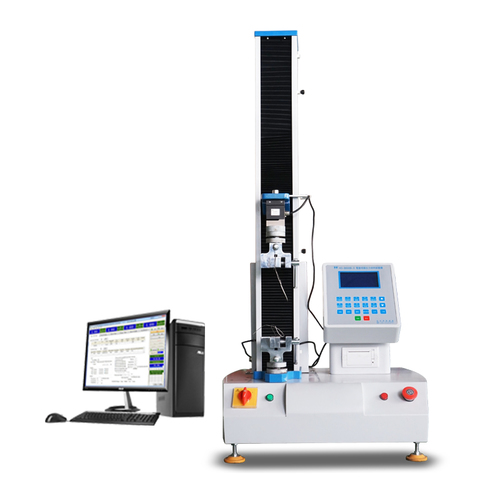
Tell us about your requirement

Price:
Quantity
Select Unit
- 50
- 100
- 200
- 250
- 500
- 1000+
Additional detail
Mobile number
Email

More Products in Universal Testing Machines Category
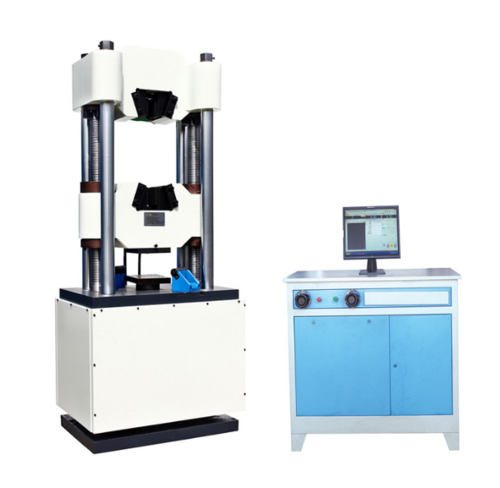
1000 kn Computer Controlled Electro Servo Hydraulic Universal Testing Machine
Price 10500 USD ($) / Unit
Minimum Order Quantity : 1 Unit
Sensor : Highprecision Load Cell
Color : Standard Industrial Grey/Blue
Power : 3 Phase AC, 380V or 415V, 50Hz
Product Type : Electro Servo Hydraulic Universal Testing Machine
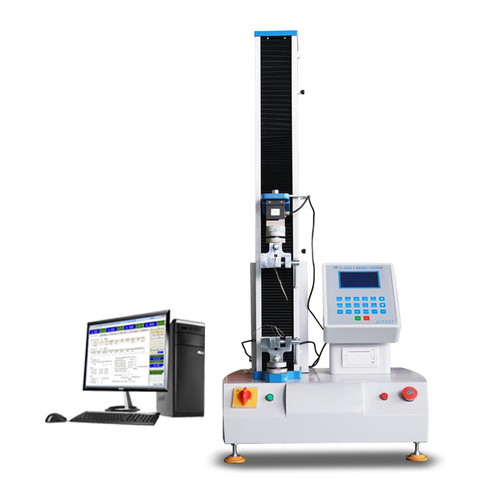
Single Column Universal Test Machine
Price 1500 USD ($) / Unit
Minimum Order Quantity : 1 Unit
Sensor : High Precision Load Cell
Color : White/Grey
Power : 220V AC
Product Type : Single Column Universal Test Machine
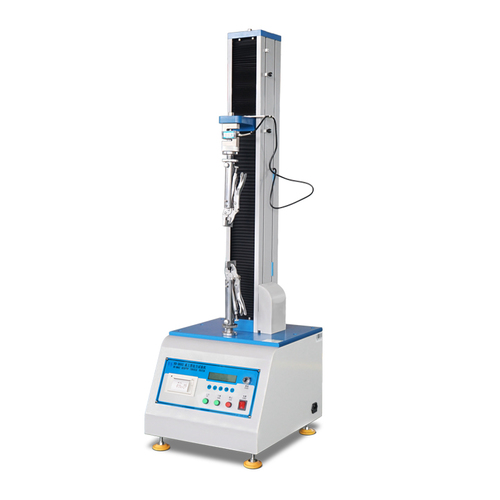
Tensile Testing Machine with 200kg Capacity
Price 800 USD ($) / Set
Minimum Order Quantity : 1 Set
Sensor : High Precision Load Cell
Color : Blue/Grey
Power : 220V AC
Product Type : Tensile Testing Machine
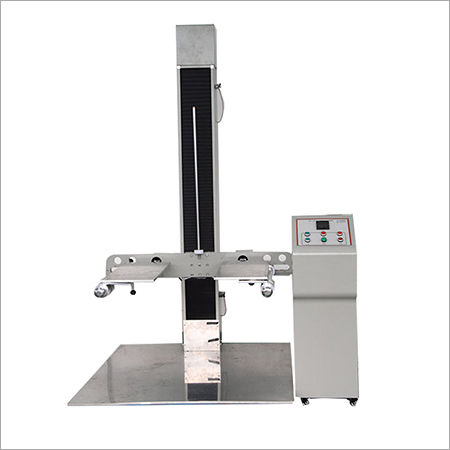
Single-Wing Packing Drop Testing Machine
Price 2500 USD ($) / Unit
Minimum Order Quantity : 1 Unit
Sensor : Drop Height Sensor
Color : Blue or Customized
Power : AC 220V
Product Type : SingleWing Packing Drop Testing Machine

Contact Details
- FACTORY ADD: No.13 Daxin Street, Daluosha Industrial Zone, Daojiao Town,Dongguan - 523710, Guangdong, China
- Phone :86-1591-7693151
- haidads@qc-test.cn
 Send Inquiry
Email us : haidads@qc-test.cn
- Ms Lisa (Manager)
- Mobile : +8613662707979, +8613829267288, +8615016776323, +8618373745787, +8618236912012, +8613602361535, +8613925747786

|


 |
HAIDA INTERNATIONAL EQUIPMENT CO., LTD.
All Rights Reserved.(Terms of Use) Developed and Managed by Infocom Network Private Limited. |
